The wingbeat of the sloppers

For a few years now I have been teaching at a prestigious engineering school (ego booster): it is an entrepreneurship major, which means the students have to build a company project around a product or a service. My session lasts about 3 hours, and my job is to shake them up a bit on the notion of a prototype, and on how, with today’s tools, it is not acceptable not to have an MVP quickly. Safe to say the content has changed a lot over the last few years, first very oriented toward no/low code, then heavily AI-ified. To my great surprise, at the last session a little over 6 months ago, I managed to impress them with a product like v0 / Lovable. I picked one of the projects at random (a sort of marketplace for musicians), asked the student for the specs, and launched v0 on it while I was doing the intro to my session. In 7 minutes his project was ready, a thousand times more finished than what he had managed so far, well helped by his excellent specifications. Then I got silence, except from the 2 or 3 people in the know who already knew v0, and the full attention of the room.
“this is great, it writes itself, but we’re still going to read what was produced”
I was able to roll out the usual caveats: I had never seen an app come out in 0-shot without functional and/or technical problems, the application almost certainly had small security holes, not much of a personality, the landing looked like thousands of other landings, with the same sections, the same button placements.
But it was usable, it was showable, and it would make it possible to validate this project idea very easily.
Now the killer question: what was the thing I had just created actually worth? With a marginal cost close to 0 (a few euros), what was going to give this project its value was not the software code, but the idea itself and the execution of it.
What I had just done was produce “slop”, disposable stuff. Originally the term was aimed more at content produced by AI, with a totally negligible marginal cost. Blog posts generated every day for SEO, for example.
Yes, the concept also applies to software. DISPOSABLE software, software I could reproduce at will, on any idea, for the same price as a burger in a brasserie rated 4.2 stars in Paris.
PART 1 The wingbeat of the sloppers
Let’s pick this back up. Your brain is stuck on a business problem, a problem you have mastered because it is your… job. “Wouldn’t it be nice if we could do it like this.” No sooner said than done, you pull out your iPhone, you open Replit / v0 / lovable, you describe what you want to do, you do 2 or 3 round trips with the AI, and boom, you have a SaaS that meets your need, with everything required: authentication, an admin, a look that’s decent enough (who cares, it’s B2B SaaS, not a designer’s application). And then the spark hits: “I built this application in 4 metro stops, I can’t be the only one with this problem, I CAN SELL IT.” Your coding agent got there before you and offers, precisely, to add a Stripe payment module. The money is yours. You are the new Benioff.
Yes, it’s true. Off you go. You are a solopreneur now, and you are going to take this application to market!
At the same moment, in Limoges, Patrick, a peer of yours whom you have never met and whom you will never meet, has the same idea. He’s not an id*ot, Patrick. He knows the AI tools too, and off he goes. His application looks a bit like yours, and so does his landing. Same button radius, same account-creation flow, same sales funnel. Patrick has already gone a bit further. He knows how to automate content production, and he starts spraying LinkedIn with AI-made posts about his product. And since he got a mic for Christmas, and a decent webcam, the YouTube channel is created right after.

Patrick coding his SaaS
At the same moment, in Tadoussac, Quebec, Charles has the same idea, same process. Almost the same application, but he knows a bit more, and he has prepared the launch of his product on Product Hunt as well as on the Apple and Android stores.
Same for Lydia in Argentina, Paolo in Portugal, and Xing in China.
Alright, I’ll stop there. You’ve got it.
Everything is going great for you. You buy AdWords so you sit at the top of the results and come in first, ahead of Patrick’s application, Charles’s, and the others’. You added an AI feature by asking your coding agent to integrate a call to the OpenAI API, but Charles and Paolo had the same idea. You start getting your first users, and of course the first bugs arrive, the first reports, which you take into account. Your coding agent starts getting worse. “Why won’t it change this f*cking button??” And it starts taking a lot of your time for a few dozen euros of revenue (and by the way, how do you declare that to the tax office??), and then, finally, a new application idea sparks. It was easy the first time, and you are going to be able to launch another one easily, and above all not make the same mistakes (just like Charles, Patrick, and the others).
But now let me tell you about Jenna.
Jenna is a developer in Oregon. Building applications is her job, and what you did in 2 hours, she can throw 15 coding agents at it, better than the one you used, running them in parallel. Jenna can produce SaaS on the fly, in series, the way Ford and his teams did with the Model T. She knows Product Hunt, the rules for publishing on the stores, she moves fast, but her applications, given the volume she produces, suffer from the same problems as yours: bugs, lazy maintenance, boredom with the idea.
This is not a butterfly’s wingbeat, but it looks like one, and it is not a hurricane but the tsunami of B2B AI SaaS slop that is coming.
Now, let’s change the angle.
All these applications end up on the stores, on the first page of Google, and they flood your LinkedIn feed with posts that contribute absolutely nothing, written by a retarded teenager (chatgpt), easy to spot by his ratio of 4 emojis per paragraph (🚀)
How is the user, a company boss with 5 employees, supposed to choose his little leave-management application, the one suited to his sector (an independent auto repair shop)?
He has to choose among dozens that offer more or less the same thing! What he wants is something that works, and that he will not have to replace in 3 months because the developer of the application said “can’t be bothered” when it came time to deal with the CSRF token problem, and preferred to shut the application down.
Because that is the very anatomy of SaaS slop: in the best case, a business need made concrete on the fly by someone who knows the trade; in the worst case, glorified “wrappers”, simple empty shells laid on top of the OpenAI or Stripe APIs. The code generated on the fly is an unmaintainable plate of spaghetti. As soon as the first complex bug hits, the “slopper” will always prefer to generate a new SaaS from scratch rather than spend 3 hours debugging the old one. It is planned obsolescence by boredom.
The platforms, the stores, LinkedIn are going to overflow with applications like these. How do you react? What strategy do you adopt? What is Tinder worth if 50% of the female profiles are bots? The whole thing becomes totally unreadable and, de facto, loses all value. It is all a question of signal versus noise. If the signal (the good application) is drowned in the noise (the 100s of clones), how do you proceed? How do you raise your hand and say “and I’m here”, above the fog and the scrum?
And wait. The worst is not that the fog, or the noise, is thick. It is that this fog becomes a weapon.
PART 2 “Weaponized Noise”
“A weapon? You’re laying it on a bit thick, my good man”
We find Patrick again. He realizes that your SaaS is starting to break through, that his is on page 2 of Google, and that his YouTube channel is not taking off. Patrick resents you a little, and he identifies you as his number 1 competitor. Patrick has an idea, dead simple, beautiful, and effective: he is going to drop you into the fog. How? By creating, for a few dozen euros, clones of your product. Imperfect clones, sure, but clones that will squat your SEO and your keywords. Patrick has dragged you back into the fog. When 500 tools all claim to be “generative AI for HR management”, the term becomes empty of meaning. Your prospect no longer even knows what to search for. It is a form of cognitive jamming that goes beyond noise. It destroys the mental categories that make comparison possible.
Not to mention another aspect: automated fake traction. Patrick equips his clones with dashboards full of fake metrics (“10,000 users”, “4.8/5 stars”), invented case studies, logos of fictional clients. Generative AI makes the manufacture of social proof almost free. And that is a weapon aimed directly at you — not just ambient noise, but an active deception pointed at your prospects.
Beyond dropping you into the fog, this attack has an effect on your prospects. If they see 150 clones of your slop product that duplicate your premium feature (or the promise of it), your innovation instantly becomes a “cheap” commodity, and that holds whether your product performs much better or not. Your competitive advantage, your “moat”, is destroyed. Your prospect? He will very likely go to Microsoft, or to another vendor that still has real respectability. In 2026, a Renault is less fancy than a BYD, but you know what you are buying and where you are going. I even believe this phenomenon is called “flight to safety” in finance, and the Reputation Premium in communications. Faced with products whose image is blurred, the prospect will naturally go toward the one that offers the most trust.
Respectability, brand image: that, too, is what is at stake with AI slop.
Remember your LinkedIn feed 2 or 3 years ago? The difference with now? Thousands of posts generated by the AI teenager I was talking about above. Slop, and more slop.
You are a company boss and you are looking for an AI expert. Which one do you pick on LinkedIn? There are thousands of them! Clones, drowning you in posts of the type “OpenAI just shipped the killer feature that just killed thousands of startups” or “I help you scale your business with AI and do *20 on your revenue”. The expert who could actually boost your revenue will be drowned in the flow of wannabes, former blockchain experts or fresh business-school graduates in t-shirts. How do you stand out? The answer is not obvious, and our expert ends up in a content race in which “winner takes all”, like on OnlyFans.
So what do we do, then? Is every good idea for a software product doomed? Is slop necessarily bound to fail?
Not necessarily. I think we are going to see professional techniques of slopping (a word I just invented, and which I am going to trademark this very minute): the hyper-niche: generate thousands of ultra-local variants (for example a tool for dog groomers in Quebec, made by Charles) to scoop up crumbs of MRR which, added together, can provide a bit of side income. the data vacuum: the free SaaS generated by AI whose only goal is to siphon B2B emails, in order to resell them or to use them on the main product pray and Pray: instead of spending six months looking for a product idea (Product-Market Fit), ask a group of agents to code and launch 50 mini-SaaS, watch the metrics, and identify THE SaaS to invest in
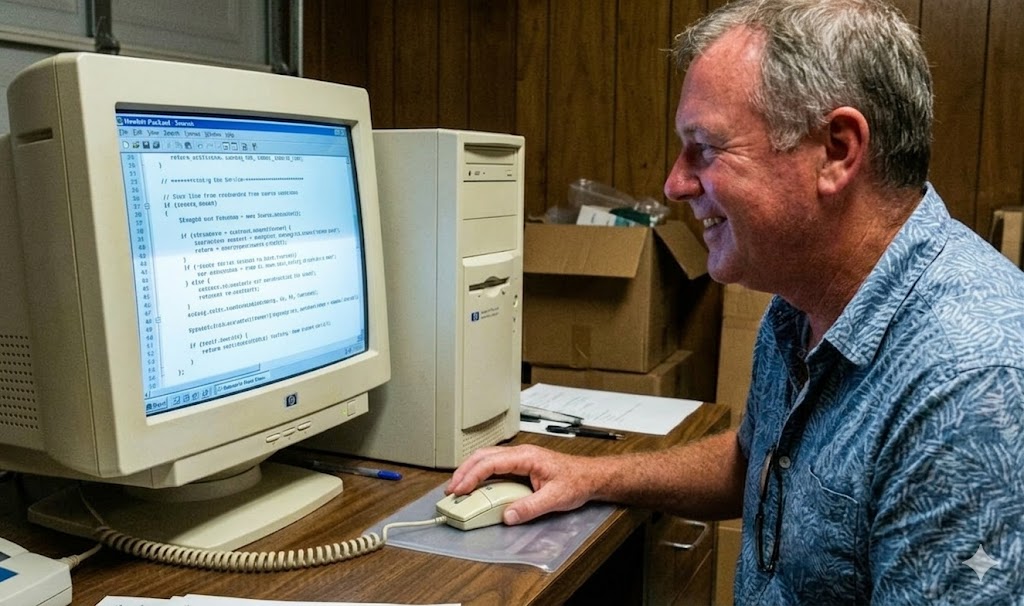
Patrick getting ready to launch his 8th SaaS on Product Hunt
Part 3 Surviving the slop chaos
Alright, the picture is a bit dark. If your code is worth the price of a bad burger, and Patrick, Charles, or Jenna can flood your market with clones over a weekend, what do we do? Do we give up on software and open a crêperie in Brittany? (especially since the crêperie in Brittany is also a kind of slop)
If the value is no longer in the line of code, that is because it has moved somewhere else. Since code has become disposable ammunition, we are going to have to build new moats (your famous moats) that cannot be prompted easily. Legal friction is a good way to protect yourself from the sloppers. Screening a CV with generative AI? Dead simple. Integrating GDPR obligations, the AI Act, consent collection, and above all your client’s legal team, on the other hand, is a whole other story. AI can write a bit of code for you, but it will not pay the CNIL fine for you if something goes wrong. Legal and regulatory liability becomes the ultimate shield. Sloppers are lazy by nature: they will flee legal complexity like the plague.
Why not imagine the Label Rouge of code? An AOC label issued by an audit agency that would come and certify applications, a macaron on your site that proves to your B2B prospects that your code is not a house of cards generated by a high-school kid in the back of beyond in Colorado, that you carry professional liability insurance, and that there are real humans behind the wheel.
You have to take advantage of this marginal cost of zero to test ideas, without forgetting that in 2026 the application is no longer a product. The product is the business complexity you master, it is the trust you inspire, it is the relationship with your client. Code is no longer a castle. It is just a pile of bricks, which in 2026 are free.
A product is also a location, a story, a reputation that makes people come and take shelter there. Two castles built with the same bricks do not have the same value — one has been lived in for 20 years, the other was just pulled out of the ground this weekend. Time and human presence are the only materials Patrick cannot prompt.
Use these tools. Crank out your MVPs in 7 minutes. Take advantage of this marginal cost of zero to test your ideas without taking a financial risk. But understand one thing: the application is no longer your product.